




.png)
.png)
Advanced K-Defense Mobility Technology Development through Drag Reduction
UWV Long-term Operation Research Lab
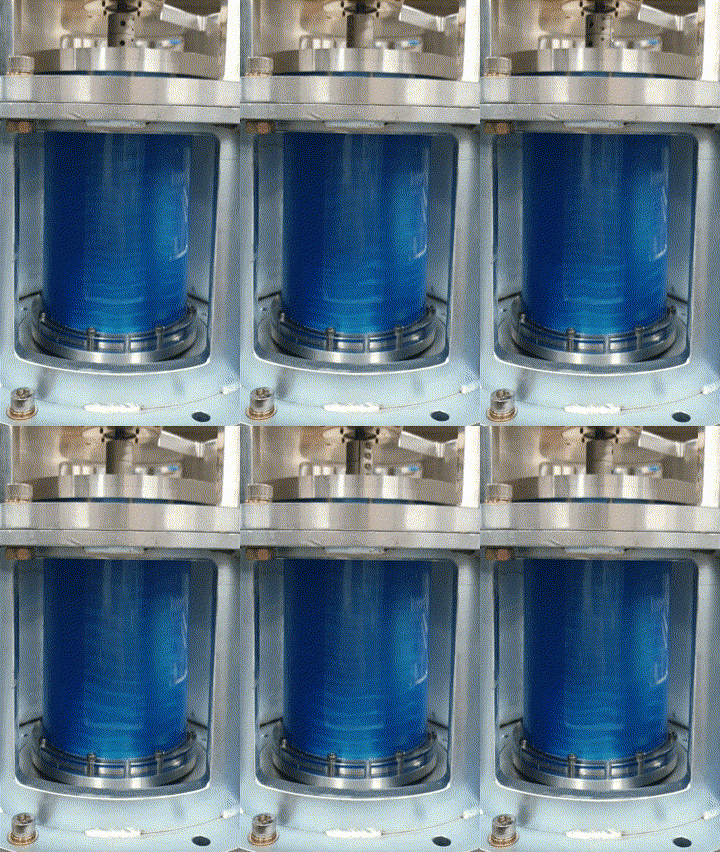
The Multiscale Heat & Fluid Flow Lab (MFL) is equipped with a Taylor-Couette flow experimental setup, enabling both friction drag measurements and velocity field analysis using 2D-PIV. In particular, the lab investigates drag reduction mechanisms by forming air layers (plastrons) on porous superhydrophobic surfaces. The system allows for pressurization, making it possible to analyze how changes in pressure affect the plastron and the resulting drag reduction. With growing military threats, there is an increasing emphasis on enhancing anti-submarine surveillance capabilities, highlighting the need for unmanned underwater vehicles (UUVs). Extending the operational duration of underwater vehicles has become a critical research focus. To this end, MFL is developing technologies to generate and retain microbubbles on superhydrophobic surfaces under high-pressure conditions found in deep-sea environments. This approach aims to reduce frictional drag and improve energy efficiency. This research is being conducted in collaboration with the UWV Long-Term Operation Research Lab (LORL) and the Agency for Defense Development (ADD).


Energy &
Environment
Future
Mobility

Publication
1.
Presentation Video
1.
2.
3.
4.
5.
6.
7.
8.
9.
Patent
1.
2.


S. Ahn, S. Jo, W. Song, H. Lee, G. Ku, M. Kim, D. Kim, S. Song, 2025, "Characteristics of turbulent Taylor-Couette flow of low-viscosity fluid on plastron-covered superhydrophobic surface", International Journal of Heat and Fluid Flow, 114, 109805
S. Ahn and S. Song "Development of Taylor-Couette flow apparatus and visualization of velocity fields", NCFE, 2020, August, 13, Jeju, Korea
S. Ahn, S. Song, "Development of PIV System and Preliminary Results for Taylor-Couette Flow", KSME Conference, 2021, Nov. 3, Gwangju, Korea
W. Song, S. Ahn, K. Pyo, S. Kim, J. Yoon, S. Song, "Evaluation on drag reduction of super hydrophobic surfaces using Taylor-Couette flow", KIMST, 2022, June. 10, Jeju, Korea
S. Ahn, W. Song, S. Song, "Measurement of friction drag and super water repellency surface flow visualization using Taylor-Couette flow", NCFE, 2022, June. 23, Changwon, Korea
W. Song, S. Ahn, K. Pyo, S. Kim, M. Kim, J. Park, D. Kim, S. Song, "Drag reduction by air layer on superhydrophobic surface in a Taylor-Couette flow", APS DFD, 2022, November. 20, Indianapolis, USA
W. Song, S. Ahn, K. Pyo, G. Ku, M. Kim, I. Jang, S. Song, "Flow Visualization of Superhydrophobic Surface Using PIV System in Taylor-Couette Flow", KSME, 2023, May. 18, Seoul, Korea
W. Song, S. Ahn, K. Pyo, G. Ku, M. Kim, S. Song, "(LORL)Drag Reduction of Superhydrophobic Surface using plastron in turbulent flow", KSME, 2023, November. 3, Incheon, Korea
S. Ahn, W. Song, K. Pyo, I. Jang, G. Ku, M. Kim, D, Kim, S. Song, "Drag Reduction of Superhydrophobic Surfaces Using Counter-rotating Taylor-Couette Facility", KSVI, 2023, November. 17, Gwangju, Korea
W. Song, H. Lee, G. Ku, M. Kim, D. Kim, S. Song, "Drag Reduction by Plastron on Superhydrophobic Surface in Turbulent Taylor-Couette Flow", KIMST, 2024, June.13, Jeju, Korea
Superhydrophobic Three-Layered Structures Film for Drag Reduction and Method of Fabricating the Same
Patent No. 10-1887075, Patent Registration Date : 2018.08.03
Superhydrophobic Porous Membrane Structure for Underwater Air Layer Holding
Patent No. 10-1974642, Patent Registration Date : 2019.04.25

UWV Long-term Operation Research Lab
Agency for Defense Development
Ministry of National Defense
Research Center & Sponsor
1.
2.
3.


Development of Pressurized Water Tunnel
UWV Long-term Operation Research Lab
The Multiscale Heat & Fluid Flow Lab (MFL) has developed a pressurized water tunnel to replicate the high hydrostatic pressure environments experienced by underwater vehicles such as submarines. This facility enables visualization of the air layer (plastron) formed on superhydrophobic surfaces (SHS) under pressurized flow conditions using a high-resolution camera system. The study focuses on maintaining and regenerating the plastron through electrolysis, even under elevated pressures and Reynolds numbers. Hue-based image analysis is employed to quantitatively assess the persistence of the plastron layer. With the increasing importance of anti-submarine surveillance in modern defense, there is growing demand for long-endurance unmanned underwater vehicles (UUVs). Extending operational duration is a key challenge, and MFL addresses this by developing techniques to generate and sustain microbubbles on SHS under deep-sea pressure conditions. This approach aims to reduce skin-friction drag and enhance energy efficiency. This research is being conducted in collaboration with the UWV Long-Term Operation Research Lab (LORL) and the Agency for Defense Development (ADD).
Energy &
Environment
Future
Mobility

Research Presentation Video
1.
UWV Long-term Operation Research Lab
Agency for Defense Development
Ministry of National Defense
Research Center & Sponsor
1.
2.
3.
Analysis of Heat Transfer in Hyperloop System
Flow Noise Research Center
As a next‑generation mode of transport, the Hyperloop is being actively developed by the Korea Railroad Research Institute (KRRI). In mechatronic systems that rely on electromagnets—such as those propelling a Hyperloop pod—thermal loads can strongly influence electrical performance. Because the magnets operate inside a near‑vacuum tube, mitigating heat in this extreme environment is critical.
The Multiscale Heat & Fluid Flow Laboratory (MFL), working with KRRI, investigated the system’s thermal behavior under design‑specific heat loads and devised cooling solutions to eliminate thermal bottlenecks. Computational‑fluid‑dynamics analyses quantified flow and cooling performance across key design parameters and confirmed the need for supplementary thermal management. Leveraging these insights, the team proposed both active and passive cooling concepts tailored to operational constraints and structural requirements.
Energy &
Environment
Future
Mobility

Research Presentation Video
1.
Research Center & Sponsor
1.
2.
Flow Noise Research Center
Korea Railroad Research Institute


AI Model Capable of Predicting Design Factors That Influence Flow Patterns
Flow Noise Research Center
The Multiscale Heat & Fluid Flow Lab (MFL) developed an AI model to evaluate the influence of changes in design factors affecting aerodynamics by using wake flow. The accurate assessment of how design changes influence aerodynamic performance is a critical challenge in the automotive design process. However, results of the traditional assessment vary depending on the experience of the evaluators performing this process when multiple designs change simultaneously. Specifically, MFL trained ResNet18 model with wake flow and its corresponding design factors using two different approaches – one is Multi-label Classification to identify whether design elements changed, enhancing interpretability through grad-CAM visualization and the other is Multi-target Regression model to quantitatively measure the extent of design element changes. As a result, both models effectively analyzed design elements and could comprehend their impact on aerodynamics. This research is being conducted in collaboration with HYUNDAI NGV.

Artificial
Intelligence
Future
Mobility

Research Presentation Video
1.
2.
3.
J. Kim, S. Song, I. Jang, J. Hong, C. Yun, "Development Of Artificial Intelligence (AI) Model Analyzing The Wake Flow To Improve Vehicle Aerodynamic Performance", KSVI, 2023, April. 20, Seoul, Korea
J. Kim, C. Yun, I. Jang, J. Hong, S. Song, "Machine Learning for Identifying Design Changes of Vehicle with Wake Flow", FSSIC, 2023, August. 31, Busan, Korea
J. Kim, I. Jang, S. Song, "Analyzing The Relationship Between Wake Flow Patterns and Design Element Changes of Vehicles Using Machine Learning", APS DFD, 2023, November. 20, Washington DC, USA
Flow Noise Research Center
HYUNDAI NGV
Research Center & Sponsor
1.
2.

Study on the Correlation Between Interior Pressure and Wind Noise in SUVs
Flow Noise Research Center
The Multiscale Heat & Fluid Flow Lab (MFL) is conducting advanced research on airflow dynamics within SUV cabins, focusing on the performance of extractor systems. Flow visualization technique called MRV(Magnetic Resonance Velocimetry) is utilized to analyze the velocity field surrounding the Extractor Grill outlet of SUVs, aiming to enhance air exhaust efficiency and reduce internal pressure. This research examines how pressure differences between the interior and exterior contribute to tonal noise, such as whistle sounds, during high-speed driving. To address this, the lab is developing optimized outlet geometries that mitigate pressure differences and improve flow characteristics at the extractor outlet. Moreover, MFL is investigating the correlation between outlet flow structures and pressure-driven tonal noise across different vehicle architectures to establish a universal SUV design framework. This research is being pursued in collaboration with the Acoustics and Vibration Lab(AVL) and is HYUNDAI NGV.
Energy &
Environment
Future
Mobility

Flow Noise Research Center
HYUNDAI NGV
Research Center & Sponsor
1.
2.
